Thirteen Apprentices Lock the Gates
On 7 December 1688, thirteen apprentice boys in Derry made a decision that would change the course of Irish history. When Alexander MacDonnell, the 3rd Earl of Antrim, arrived with a regiment of 1,200 Catholic soldiers to garrison the city, these young Protestant apprentices took matters into their own hands. They rushed to the Ferryquay Gate and slammed it shut. The Earl's regiment was refused entry. This act of defiance, born of suspicion that James II sought to strip Protestants of their rights, ignited a conflict that would define the city for centuries.
The Historical Context
The siege occurred during one of the most turbulent periods in British and Irish history. In November 1688, William of Orange had invaded England. By December, the Catholic King James II had fled to France. In February 1689, William and Mary were declared joint monarchs. James, however, retained significant support in Ireland, where Catholics constituted approximately 75 per cent of the population. Ireland became the battleground for the wider struggle of the Williamite War.
James landed at Kinsale on 12 March 1689 with French officers and troops. His strategy was clear: establish Ireland as a Jacobite stronghold from which to reclaim his throne. Derry, a predominantly Protestant city with formidable defences, stood in his path.
James II at the Walls
The formal siege began on 18 April 1689, when James II himself appeared before the city's walls. He summoned the defenders to surrender. The response was unequivocal. From the ramparts, the defenders shouted "No Surrender!" and fired a cannon, reportedly the great gun known as "Roaring Meg," directly at the King's position. James withdrew, humiliated. The 105-day siege had begun.
The city's population had swelled dramatically. From approximately 2,500 residents in December 1688, Derry now held more than 30,000 people. Refugees from the surrounding countryside had flooded in, seeking protection behind the walls that had been constructed between 1613 and 1619.
Leadership and Early Setbacks
The siege's early days were marked by command upheaval. Governor Robert Lundy had advised abandonment of the city, arguing that resistance was futile. He fled on 16 April, disguised as an ordinary soldier. His effigy is still burned annually by the Apprentice Boys of Derry.
Henry Baker was appointed governor on 19 April. George Walker, a clergyman, was put in charge of stores. John Mitchelburne commanded the military defences. Together, they would lead the city through its darkest hours.
The Jacobite forces, numbering approximately 21,000, vastly outnumbered the defenders, who mustered around 8,000 men. The attackers were led by Richard Hamilton, a professional soldier who had previously been imprisoned in the Tower of London before being released. French generals commanded significant portions of the besieging army, including Conrad de Rosen, who arrived in June to intensify the siege.
The Battle of the Passes and Early Engagements
On 15 April, the Jacobites achieved an early victory at the Battle of the Passes at Cladyford, breaking through defensive lines outside the city. Yet the city itself remained impregnable.
The defenders proved resourceful. On 21 April, a sally from the walls killed the French General Jacques de Fontanges, Comte de Maumont, at the Battle of Pennyburn. On 25 April, further sallies wounded James FitzJames, the 1st Duke of Berwick (James II's illegitimate son), and Bernard Desjean, Baron de Pointis, and killed another French general, Jean Camus, Marquis de Pusignan.
By 30 May, the besiegers had received heavy guns and mortars. They would fire nearly 600 explosive shells into the city.
The Boom Across the Foyle
The Jacobites recognised that relief by sea posed the greatest threat to their siege. On 3 June 1689, they constructed a massive boom across the River Foyle, halfway between Derry and Culmore. Made of timber cables and chains, it was designed to block any relief ships from reaching the starving city.
The situation inside the walls grew desperate. Disease and hunger took hold by May. The population was forced to eat dogs, horses, and rats. By the siege's end, approximately 4,000 defenders would die, mostly from starvation and disease; roughly half of the city's population.
The Relief: Mountjoy and Phoenix
The breakthrough came on 28 July 1689 (Old Style; 1 August by the modern calendar). Three ships sailed up the River Foyle. The armed merchant vessels Mountjoy and Phoenix led the way. HMS Dartmouth, commanded by Captain John Leake, provided covering naval gunfire.
The Mountjoy rammed the boom at Culmore fort. The obstruction gave way. Tons of food were unloaded to relieve the starving population. Three days later, on 1 August 1689, the Jacobite forces burned their camps and departed. The siege was lifted.
The Maiden City
Derry's walls had never been breached. This achievement gave rise to the city's enduring nickname: the "Maiden City." The walls, completed in 1619 under the direction of the Irish Society with architect Peter Benson, had withstood 105 days of assault, bombardment, and starvation tactics.
The siege's impact on Derry's identity cannot be overstated. It cemented the city's status as a Protestant stronghold in predominantly Catholic Ireland. The cry of "No Surrender" became an enduring loyalist slogan. The bravery of the thirteen apprentices, the resilience of the defenders, and the dramatic relief by the Mountjoy and Phoenix became central to local mythology.
Modern Remembrance
The siege is commemorated through the Apprentice Boys of Derry, a Protestant fraternal society founded in 1814. With over 10,000 members worldwide, the organisation maintains eight parent clubs: the Apprentice Boys, Walker, Mitchelburne, No Surrender, Browning, Baker, Campsie, and Murray clubs.
Two major annual celebrations mark the siege:
The "Shutting of the Gates" takes place on the first Saturday in December, commemorating the apprentices' action on 7 December 1688. The ceremony includes the burning of a Robert Lundy effigy and a service of thanksgiving at St Columb's Cathedral.
The "Relief of Derry" is held on the second Saturday in August. This parade, which attracts approximately 10,000 marchers and 127 bands (based on 2007 estimates), is the largest parade in Northern Ireland. It is accompanied by the week-long Maiden City Festival, which includes bluegrass music, Irish and Ulster Scots performances, arts exhibitions, and events staged by the city's Chinese, Polish, and other minority communities.
Siege Sites Still Standing
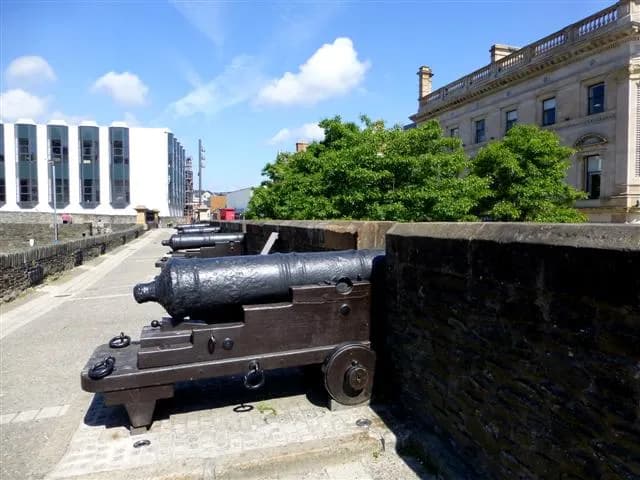
Visitors to modern Derry can walk the same walls that withstood the 105-day siege. The circuit is approximately one mile and remains fully accessible on foot. Twenty-two cannons from the 16th to 18th centuries still stand on the walls, including "Roaring Meg."
The four original gates remain: Ferryquay Gate, where the apprentices made their stand; Shipquay Gate, offering direct access to the River Foyle; Bishop's Gate, replaced with a triumphal arch in 1789; and Butcher's Gate, named for the street where the city's butchers plied their trade.
St Columb's Cathedral, consecrated in 1633 as the first purpose-built Protestant cathedral in Britain and Ireland after the Reformation, holds siege documents, the original city keys, portraits of William of Orange, and the "Bomb Font" made from a cannonball. The first thanksgiving service for the siege's relief was held here on 8 August 1689.
The Apprentice Boys Memorial Hall on Society Street, opened in 1877 and extended in 1937, houses a museum and serves as the organisation's headquarters. In 2012, the hall received £2 million in EU funding for a new visitor centre.
The Walker Memorial Plinth stands at the Royal Bastion, marking the site of the original 81-foot Walker Pillar erected in 1826. The monument was destroyed by an IRA bomb in 1973, but the plinth was restored for the siege's 300th anniversary.
A Complicated Legacy
The siege's commemoration has not been without controversy. In 1969, an Apprentice Boys parade sparked three days of rioting in the Bogside, an event widely considered the beginning of the Troubles. The Walker Pillar was destroyed by an IRA bomb in 1973. In recent decades, however, the commemorations have taken a more conciliatory approach, with parades in recent years described as virtually trouble-free.
What remains undeniable is that the 105-day siege of 1689 fundamentally shaped Derry's identity. The walls that never fell, the apprentices who locked the gates, the ships that broke the boom, and the cry of "No Surrender" continue to resonate through the city's streets, festivals, and collective memory more than three centuries later.
